52 years ago (Nov. 29, 1965) the Berkshire Eagle printed a little article about two young men being fined 25 bucks for dumping trash. Little did we know at the time that the incident, which ran on page 25, would become the basis for Arlo Guthrie's Alice's Restaurant. Here's our original story from 1965: Source

"Alice's Restaurant" - A Thanksgiving Eve Tradition on American Pastimes
Tom Leonardi
According to his biographer Joe Klein, “one of the last things that Woody Guthrie did before he died was to listen to a recording of his son Arlo singing a long, convoluted talking blues about how he’d been arrested for littering in Stockbridge, Massachusetts, and how he’d parlayed that ‘criminal record’ into a means of dodging the draft and avoiding the war in Vietnam.” Whether Woody could actually comprehend the story or even knew it was Arlo singing and story telling will never be known. He was in the final stages of the neurologically debilitating Huntington’s Disease and would succumb to it within a few short weeks.
Because of Arlo's recording however, fame came to Woody’s oldest son much earlier in life than it came to him. Arlo Guthrie was raised in Howard Beach in Queens, New York. He had just graduated from the Stockbridge School in Stockbridge Massachusetts where he had met Alice & Ray Brock who both taught there. The couple lived in an old church and served large meals for friends and family. On Thanksgiving Day in 1965, 18-year-old Arlo and his classmate Rick Robbins were arrested in Stockbridge by police officer William Obanheim for dumping trash left over from Thanksgiving dinner at the Brocks. The two had originally planned on taking it to the town landfill but it was closed for the holiday. In court a few days later they pled guilty.

Courtesy of the Guthrie Center
The judge, the Hon. James E. Hannon was actually blind. And as Arlo points out, “in a typical case of American blind justice” he found them both guilty, fined them $50, and made them collect their garbage. Guthrie and Robbins hit the road as performers immediately afterward. According to Robbins, “we followed the footprints of Woody and Cisco [Houston].” The original song “Alice’s Restaurant” was a fauxadvertising jingle that Arlo had composed for the Brocks. He began to include it in his stage repertoire and during performances he started telling the story of their arrest and conviction and its effect on his Viet Nam era draft status: "you want to know if I'm moral enough to join the army, burn women, kids, houses, and villages.... after being a litterbug?"
But it wasn’t until 1967 that the song and story reached a larger audience. That year he performed it at the Newport Folk Festival and then during a WBAI radio broadcast. WBAI is the New York City Pacifica station; a non-profit community station. Arlo’s performance was hugely popular and often requested by the station’s listeners but WBAI only played the tape during fund-raising pledge drives. Its popularity in New York served to get Arlo a record contract and the song was released in 1967 on a long-playing album (at 18 minutes long the song and monologue couldn’t fit onto a 45 rpm single). The album reached #17 on the pop charts. A 45-rpm single called "Alice's Rock 'n Roll Restaurant" was also released by the record company but predictably it tanked.
In 1969 United Artists and director Arthur Penn released a film version of the story that featured Hollywood actors as well as Stockbridge locals including Officer Obanheim. Said Officer Obie: “If anyone is going to make me look like a fool, it will be me."

Officer Obie
As Arlo performed “Alice’s Restaurant” throughout his career he would periodically change the monologue to reflect current social concerns and political situations. A few of these other versions have been released on CD. "Alice: Before Time Began" was first recorded in 1969. Its satirical account of cockroach armies took on the military. A version recorded in 1990 at the Kerrville Folk Festival addressed policies of the first President Bush.
In 1997 Arlo re-recorded his entire debut album for CD: This recording, "Alice's Restaurant: The Massacree Revisited" includes an updated narrative that involves a visit to Jimmy Carter’s White House and a discovery there related to Richard Nixon. One version or another of “Alice’s Restaurant” has been featured on American Pastimes every Thanksgiving Eve since KZFR has been gracing the airwavs.
Arlo purchased the old Trinity Church in Stockbridge in 1991. The church, formerly owned by the Brocks and site of the infamous 1965 turkey dinner has been developed into The Guthrie Center, a non-profit interfaith church foundation dedicated to providing a wide range of local and international services.
Alice Brock went on to open a variety of restaurants and has written a number of cookbooks. Officer Obie was forced into retirement after over 30 years on the Stockbridge police department. He evidently beat up another peace officer.
Rick Robbins, Arlo’s friend and co-conspirator in garbage dumping continued to sing and tour into the late 1970’s when he settled down and became an architect and house builder. In the mid 1990’s he began to perform again, recording a number of CD’s with musical support from Rory Block, Eric Weisberg, John Sebastian, Garth Hudson, and others. In recent years he has toured extensively with Ramblin’ Jack Elliot. SOURCE:
The secret Jewish history of “Alice’s Restaurant”

You want to feel old?
This is the fiftieth anniversary of the song “Alice’s Restaurant,” by Arlo Guthrie.
Well, sort of. The song was released on the album of the same name in September, 1967. The events that the song commemorates actually occurred two years before that, on Thanksgiving, 1965.
But, nevertheless, if you are of a certain age, nothing says Thanksgiving more than “Alice’s Restaurant.”
For those of you who don’t know what I am talking about, here is a Cliff’s Notes version.
“Alice’s Restaurant” consists of Arlo Guthrie delivering a long, guitar-accompanied monologue (a talking blues, really — an art form that his father, the iconic American folk singer, Woody Guthrie, had perfected) about his arrest for littering in Stockbridge, Massachusetts, by the Stockbridge chief of police, William Obanhein, a.k.a. Officer Obie.
At the time, Arlo was living with Alice and Ray Brock in a deconsecrated church in Great Barrington, Massachusetts (more about that later).
Ultimately, as the song’s second part tells us, Arlo’s arrest record was at least partially responsible for preventing him from being drafted and serving in the war in Vietnam.
Two years later, the movie “Alice’s Restaurant” was released. It stars Arlo as himself.
Jewish geography lesson: For many years, I spent summers in the Berkshire mountains of western Massachusetts, where the song takes place. For me, and for so many, the Berkshires are a magical place — the only place where I ever truly relax.
The discerning tourist can find all of the places mentioned in the song (with the exception of the scenes at the draft board, which take place on Whitehall Street in New York City).
- In Stockbridge, you can visit the original location of Alice’s restaurant; it is, in fact, “around the back, just a half a mile from the railroad track” off Main Street.
- For many summers, I used to dump our trash at the Stockbridge town dump, which is probably where Arlo should have dumped his trash in the first place. I could do that, legally, because I had a sticker from the “master garbologist.”
- Officer Obie’s extended family still lives in the area; he was a well-known and beloved figure.
As for the church, it is still there, as well. It serves as the Guthrie Center, a wonderful concert venue, and home to the Guthrie Foundation, a permanent memorial to the legacy of Arlo’s late parents.
(Check out this song about Woody’s legacy, written and sung by my friend, Doug Mishkin).
Which brings me to the Jewish stuff.
Arlo Guthrie is Jewish, through his mother, Marjorie Mazia Guthrie.
Fun fact: when Arlo celebrated becoming bar mitzvah, at the Howard Beach Jewish center in Queens, the presiding rabbi was none other than Meir Kahane.
Kahane would go on to become the leader of the Jewish Defense League, and then, in Israel, of the extreme right wing, anti-Arab Kach party.
Kahane was assassinated in 1990 by El Sayyid Nosair, who was linked to Osama bin Laden — thus becoming the first American victim of Al Qaida.
Arlo Guthrie and Meir Kahane — together. Think of it.
Back to Woody Guthrie.
Guthrie was not Jewish, and yet, he wrote a bunch of Hanukkah songs. This one is one of my favorites.
Guthrie’s guitar was adorned by a simple message, placed there in 1941: “This machine kills fascists.”
As we prepared to enter World War Two, it was the right message.
And, while we are not fighting foreign wars against fascists right now, the anti-fascism sentiment still stands.
One last thing about Woody Guthrie.
When Guthrie lived in Brooklyn, he lived at the Beach Haven apartments, which was a property that had been developed by Fred Trump — as in the father of the current president.
As others have noted, the older Trump was not particularly interested in having blacks rent his properties.
Which would lead Woody Guthrie to write a song about Fred Trump:
I suppose Old Man Trump knowsJust how much racial hatehe stirred up in the bloodpot of human heartsWhen he drawed that color lineHere at his eighteen hundred family project.
The spirit of protest, birthed by Woody Guthrie and sustained by Arlo, is still alive in our time.
And for this, we surely must give thanks. SOURCE
Woody Guthrie's Hanukkah Songs
Joshua Eli Plaut
 Here is a recent American tale of old wine in new vessels. Part of our national folklore reveals that Woody Guthrie, the iconic American folk troubadour and songwriter, composed Hanukkah songs. In a 2003 concert, the Klezmatics, a popular Grammy Award-winning Klezmer band, performed Hanukkah songs showcasing lyrics written from 1949 through the early 1950s by Woody Guthrie. The lyrics had laid fallow and long-forgotten in Guthrie’s archives until their discovery in 1998 by Woody’s daughter, Nora Guthrie. Nora asked the Klezmatics to write original music for the lyrics, which fuses strains of Klezmer music with American folk and bluegrass. The 2006 album, “Woody Guthrie’s Happy Joyous Hanuka,” comprises many different songs, including “Happy, Joyous Hanuka” and “Hanuka Tree.” Two of the eight songs, “The Many And The Few” and “Hanuka Dance,” had lyrics and melodies penned entirely by Guthrie. The songs were in part biographical. Woody was married to Marjorie Mazia, a Jewish dancer with the Martha Graham Dance Company who was the daughter of Aliza Greenblatt, an activist and Yiddish poet. Nora remembers “For Hanukkah actually, we had a hat—we didn’t get presents—but we had a hat with different amounts of Hanukkah gelt, and every night we’d pick out five cents or twenty-five cents of gelt. My mother played piano, and we used to sing and dance every night.”*
At the 2003 debut concert with the Klezmatics at the 92nd Street Y in Manhattan, folk legend Arlo Guthrie, Woody’s son and Nora’s brother, joked that as children they would dance “around the Hanukkah tree.” "Happy Joyous Hanuka" counts down each candle on the menorah (“Seven for the sons of Hannah that died/Six for kings and the tricks they tried/Five for the brothers Maccabee”), while “Hanuka Tree” has a lively simple melody (“Round and around my Hanukah tree/Round and around I go/Round and around my Hanukah tree/Because I love you so”). According to Nora, most of Woody Guthrie’s Hanukkah songs seem to  have been written in November or December within five days of each other “because he had bookings in December for children’s Hanukkah parties in assorted Brooklyn community centers.” As was his wont, Woody would “write songs only for the gig a few days before and then go on to other songs for other gigs.” For the Guthrie family, a family of improvisers not of traditions and for whom the approach to religion was “all or none,” the tree was a “Christmas tree, a Hanukkah tree, and a holiday tree. It was a fluid thing!”
have been written in November or December within five days of each other “because he had bookings in December for children’s Hanukkah parties in assorted Brooklyn community centers.” As was his wont, Woody would “write songs only for the gig a few days before and then go on to other songs for other gigs.” For the Guthrie family, a family of improvisers not of traditions and for whom the approach to religion was “all or none,” the tree was a “Christmas tree, a Hanukkah tree, and a holiday tree. It was a fluid thing!”
Indeed, the popularization of Woody Gutherie's Hanukkah songs by the Klezmatics demonstrates the vital role that music plays as an intrinsic cultural force contributing to the Americanization of this Jewish holiday, as it coexists with Christmas.
*Telephone interview with Nora Guthrie, August 17, 2011.

Aliza Greenblatt (Yiddish: עליזה גרינבלאַט, September 8, 1888 – September 21, 1975) was an American Yiddish poet. Many of her poems, which were widely published in the Yiddish press, were also set to music and recorded by composers including Abraham Ellstein and Solomon Golub and were recorded by Theodore Bikel and Sidor Belarsky, among others.
Her daughter Marjorie, a dancer in the Martha Graham Dance Company, was for a time married to folk musician Woody Guthrie. Greenblatt was the grandmother of folk musician Arlo Guthrie
Alice Brock: An Artful Life
 by Jeannette de Beauvoir
Alice Brock is no washashore. “I was conceived on Long Point,” she says, smiling. “Oh, wait, you don’t want to start that far back?”
It doesn’t matter how far back you begin in Alice Brock’s life; it’s all interesting, as attendees at the Heritage Day that will be celebrated in her honor at the Provincetown Public Library on June 13 will get a chance to hear.
Maybe it started out on Long Point. Or maybe it started during the summers her father worked for Peter Hunt and the family lived on Commercial Street—“the best summers of my life,” says Brock. She decided then that she wanted to live in Provincetown forever.
There were a couple of rather famous detours on her way back here, however. Brock got married and headed out to Stockbridge to teach at a prep school run by a left-leaning scholar whose assumption was that everyone—faculty, staff, and students—were equals. “It was the mid-sixties,” Brock remembers. “My husband played the guitar, kids would come and hang out at our house on campus all the time. We were bohemians…or maybe beatniks.”
One of the kids who played and sang with Brock and her husband was Arlo Guthrie.
Brock’s mother bought the couple a church as a wedding present; her husband, an architect and sculptor, turned it into living quarters. It was a magical place, complete with bell tower and an arch made by New Bedford shipbuilders who simply reversed their usual approach to curves and space. Parents trusted Brock and her husband, as they were teachers, and more and more kids came to stay, to play, to talk. “But there I was, cooking for all those voracious teenagers!” says Brock. “That had to stop.”
Her mother found the solution: “She said, ‘there’s a diner in Stockbridge that’s for rent. I’ll help you, and you can get paid for your cooking.’” Brock smiles. “I always leap before I look, so I said, why not?”
That leap eventually brought about her extraordinarily popular cookbook, Alice’s Restaurant Cookbook, not to mention a song that became an anthem for the age, Arlo Guthrie’s anti-war hymn, Alice’s Restaurant. It was a golden time. “I loved it; it was all a lot of fun. Arlo’d been called up for the draft and that’s when he came up with the song…We were just all these hippies against the war. We lived as if the world was the way we wanted it to be.” She pauses. “That’s the way we still live.”
It was time to go to Provincetown. “I’m very lucky, because I don’t care about money,” says Brock. “When I run out of money, some more comes in, somehow. I spend the money on other people, and as it goes out it makes room for more to come in.”
Although she never took an art class, Brock had always been making things. “I love to recycle objects,” she says. “I even used to carve little figures out of sticks of chalk. I made a movie out of a roll of adding-machine tape, with narration. I always felt I was an artist, but I never saw it as a way to make money, it was all very personal. Before moving here, I had one art show in the Berkshires. Everything got sold—and I felt completely bereft! Then I came to Provincetown and I was part of a fall arts festival. I hung things for the first time—for the first time, I had a gallery. And I loved having a gallery!” She had that gallery for the next forty years. “I always enjoyed talking with all the people who came in…you have to understand, the sixties, it was a wonderful time for most people, and they love going back to that time. And so I sold art!”
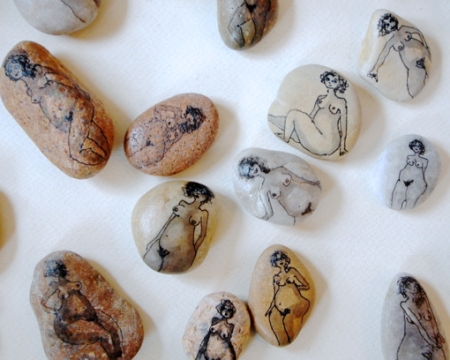
And she has continued to sell art. Her stones, adorned with pictures of women and of cats, can be found literally all over the world. While she no longer has a gallery on Commercial Street—“this is the first time that I don’t have a view of the water”—this summer on weekends she’ll be in one of the art shacks on MacMillan Pier, where everyone will have the opportunity to take home an Alice Brock painting, stone, or book.
Though she now has emphysema and requires oxygen, Alice Brock is still creating, and still in love with the place where she was conceived. “I love Provincetown with all my heart,” she says. “Every day I feel blessed to be here.”
Alice Brock will be the guest of honor at this year’s Provincetown Heritage Day celebration at the Provincetown Public Library, 356 Commercial St., on Tuesday, June 13 at 6 p.m. The event will feature a Q&A with Brock and is free and open to the public. For more information call 508.487.7094 or visit provincetownlibrary.org.
69 Commercial Street

 Alice Brock Studio | R & R Place
Anyone of a Certain Age will almost certainly share the author’s quiet pleasure in knowing that Alice M. (Pelkey) Brock, the Alice of Alice’s Restaurant, wound up practicing her delightful art right here in Provincetown. She moved to Cape Cod in 1979 and declared three decades later that she was grateful for every “beautiful day in paradise” (Jane Roy Brown, “After Alice’s Restaurants,” The Boston Globe, 24 February 2008). “Thank God for the National Seashore,” she said. “There’s still the beautiful light, and there are still a few crackpots left. I never want to go anywhere. People say, ‘Don’t you want to go away in the winter?’ The only place I would want to go would be a place like this, and I’m here now.”
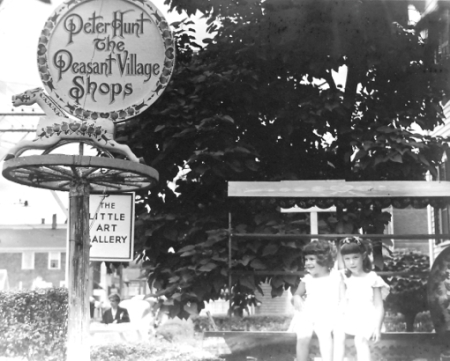
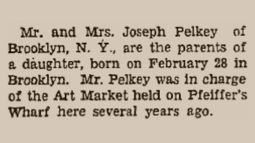
 In fact, she had been here before. Though Brock is closely associated in the popular mind with Stockbridge, Mass., her Provincetown bona fides are exceptional. Her parents were Mary Dubro Pelkey (±1909-2010) and Joseph F. Pelkey (1911-2010), who met here. As Brock herself notes, she was conceived here. And even though she was born in Brooklyn, her arrival was announced in the pages of The Advocate. Pelkey, a professional silkscreener and alumnus of the Cranbrook Academy of Art, had made a name for himself locally working with Peter Hunt, managing the Christmas Tree Shop at 443-445 Commercial Street. Pelkey also ran the Art Mart on a wharf near the center of town, 251-253 Commercial, known variously as Jot Small’s, Heinrich Pfeiffer’s or Charley Cook’s. And he was an Advocate contributor.
The Pelkey family — father, mother, two girls and one dog — spent summers in Provincetown, living in a big room behind the Christmas Tree Shop. There is a charming picture of Alice and her sister, Zina, seated outside Hunt’s Peasant Village complex at 432 Commercial Street. Harry Kemp dedicated a poem to Pelkey in 1944; one of his better ones, in fact. “Last Word,” it is titled.

Brock’s name entered the national lexicon in 1967 with the release of Arlo Guthrie’s Alice’s Restaurant Massacree. “Alice’s Restaurant is not the name of the restaurant, that’s just the name of the song,” Guthrie said at the beginning of an 18-minute talking blues ballad about his arrest for illegally dumping debris from Ray and Alice Brock’s home after discovering that the Stockbridge town dump was closed on Thanksgiving. The jauntily meandering song is, by and by, a lampoon of the police and the Selective Service System and the stupidity of officialdom in general; popular enough in its time that it inspired a movie, Alice’s Restaurant (1969), in which Pat Quinn played Alice. The song is still broadcast on radio stations around the country as a Thanksgiving Day anthem.
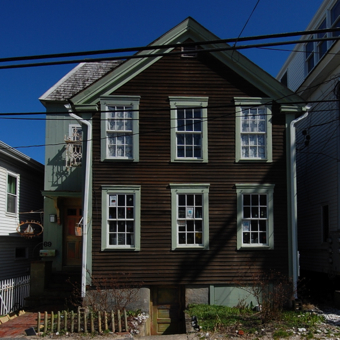
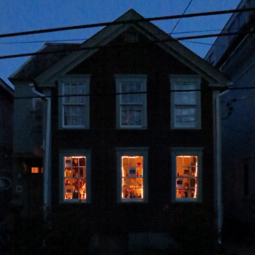 Brock got out of the restaurant business long ago. With Davis E. Gates, she purchased 69 Commercial Street in 1983 from Francis P. and Elizabeth A. Kelley. The house was constructed around 1860 and was the property of William A. Couilliard at the turn of the 20th century, when it was denominated 52 Commercial Street. Adeline and Emil Souda acquired it from Couilliard in 1942. Adolphe Robicheau, who acquired it from Marie Souda in 1962, undertook some astonishing changes, many of which Brock inherited.
Robicheau, a ballet dancer and instructor from Nova Scotia, operated 69 Commercial as a boarding house. He also transformed it into a dramatic expression of Catholic piety, drawing on his talents as a set painter for the Boston Ballet. He built a private chapel on the third floor that was consecrated by the bishop of Fall River, Brock said. He installed a pipe organ, an altar, stations of the cross, a baptismal font, a prie-dieu and icons. A lot of them. “The whole house was filled with icons,” Brock recalled, “including martyrs with their eyes gouged out.” She removed almost everything but a stained-glass window.
 Brock divided the property into condominium interests in 2007 and sold the bottom part of the house to Richard Allan O’Reagan (b 1963). He is one of the Rs in “R & R Place,” as the sign says over the side entrance to his unit. The other R is Richard Allen Hanson II, whom O’Reagan married in 2011.
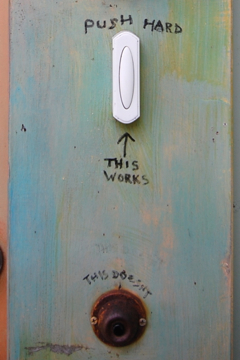
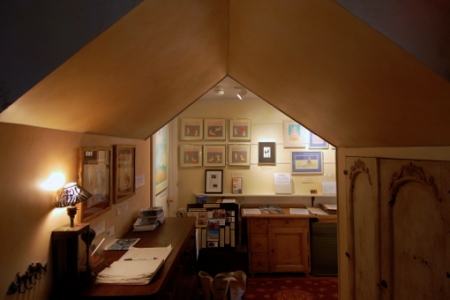
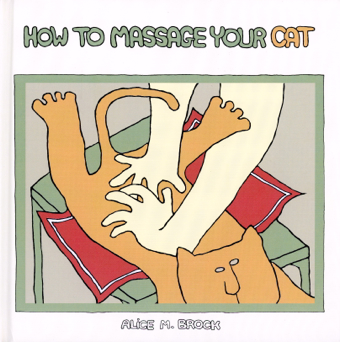
No. 69 is now the Alice Brock Studio, where Brock sells her artwork. She is the author or illustrator — or both — of Mooses Come Walking, written with Guthrie (Chronicle Books, 2004), How to Massage Your Cat (Chronicle Books, 2003), My Life as a Restaurant (Overlook, 1976) and Alice’s Restaurant Cookbook (Random House, 1969).
“I never formally studied art or took lessons, but all my life I have made things, drawn pictures and illustrated stories,” Brock said in an artist’s statement. “Being an artist was never a career choice. It’s my survival technique. Until recently, I rarely showed my work in public”
“I am a serial painter. One is never enough. There are so many possibilities. I want to explore them all. I enjoy repeating images in various configurations. The dynamics of relationships intrigues me. In my mind, objects have personalities, shapes can convey emotions and every carrot has a story.
“One of my favorite materials is the common beach stone. I draw on them and then I put them back on the beach. I also put them along the bike paths, behind the baked beans in the supermarket, on fence posts and in flower pots. And I sell them.”

Found by serendipity (when not purchased), the stones have wound up being placed in or carried to the Museum of Modern Art, the Tate, the Louvre and the Hermitage; the top of Denali and the bottom of the Grand Canyon; and beaches in New Zealand and Venezuela. One was tossed over the Great Wall of China. I like the idea that Alice Brock found her way back home to Provincetown after many years of journeying and now dispatches little bits of Provincetown — and herself — on journeys of their own.